In Arrowhead Capital Fin. Ltd. v. Seven Arts Entertainment, Inc. 2016 U.S. Dist. LEXIS 126545 (S.D.N.Y. Sept. 16, 2016), District Judge Katherine Polk Failla imposed significant sanctions upon both the Chief Executive Officer (“CEO”) and the lawyer for defendant Seven Arts Entertainment Inc. (“SAE”).

Background

Arrowhead Capital Finance, Ltd. (“Arrowhead”) sued SAE in 2014 seeking to enforce a judgment

Continue Reading Client’s Bad Behavior Imputed to Counsel – Both Get Sanctioned

A key word search is a basic search technique that involves searching for one or more words within or across a collection of documents/files. Typically, the purpose of a key word search in a litigation is to limit the universe of potentially responsive data that one must process and review in order to prosecute/defend a lawsuit.  (Note, this blog relates

Continue Reading Key Word Searching – What Is It? And How Do I Do It (Well)?

Lawyers often worry about their obligation to preserve relevant information.  As a result, one may direct their client to collect all potentially responsive information.  However, over-collecting is a significant cause of costly e-discovery.  So, what is a lawyer to do?

It is critical not to conflate preservation and collecting. 

While collecting is one way to preserve information, it is a

Continue Reading Preserving vs. Collecting – What’s the Difference? And, Why Does it Matter?

The amendment to Federal Rule of Civil Procedure 26(b)(1) (which defines the scope of permissible discovery) did away with the timeworn “reasonably calculated to lead to the discovery of admissible evidence” standard.  In its place is now the “proportionality standard,” which explicitly imposes a responsibility on litigants to tailor their discovery requests to account for the significance of the information

Continue Reading Proportionality Is the Critical Inquiry in Federal Court Discovery

In Hyles v. New York City et. al., (Case No. 10-3119, 2016 U.S. Dist. LEXIS 100390 [S.D.N.Y. Aug. 1, 2016], the plaintiff, an African-American female employed by the City of New York, was demoted.  Specifically, she was replaced by a white male and demoted to a different position with a lesser salary.  Ultimately, plaintiff sued the City for discrimination

Continue Reading The Southern District of New York Rules that It Cannot Force a Responding Party To Use Technology Assisted Review When Searching for Documents

Federal Rule of Civil Procedure 37 (along with others — Rules 1, 16, 26 and 34) was amended, effective December 1, 2015.

The amendment to Rule 37(e) was intended, in part, to ensure practitioners/litigants were fully aware of their preservation obligations, to ensure a uniformity of sanctions imposed upon parties and practitioners who failed to preserve discoverable electronically stored information

Continue Reading E-Discovery Update: ESI Sanctions in Federal Court During 2016 (Well, through July)

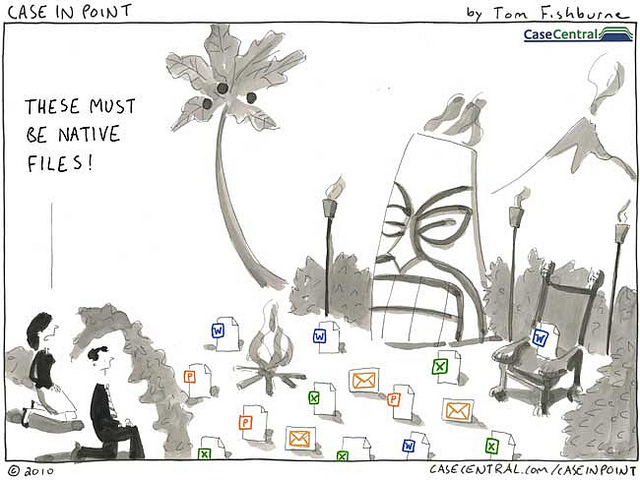
Production of documents in their “native file format” is gaining traction in litigation.  But, what exactly is a native file? And why should I care about it?

Native format is the file structure of an electronic document as defined by the application that created that electronic document.

So, for example, if a spreadsheet was created using Microsoft Excel, then that

Continue Reading What is a Native File and Why Does it Matter?

In the well-known saga commonly referred to as “deflategate,” (NFL Mgmt. Council v. NFL Players Ass’n., 2016 WL 1619883 [2d Cir. Apr. 25, 2016]) the Second Circuit upheld the arbitrator’s decision to suspend Patriots’ quarterback, Tom Brady.  Specifically, Brady, was suspended for four games after it surfaced that he participated in deflating the footballs used in Superbowl XLIX

Continue Reading Any Reasonable Litigant Should Understand Not to Destroy Evidence.

In Thurmond v. Bowman, 2016 WL 1295957 (W.D.N.Y. Mar. 31, 2016), a Fair Housing Act case, defendants moved for sanctions against the plaintiff alleging plaintiff deleted Facebook posts relevant to this lawsuit. The plaintiff argued that the posts were not deleted, but instead were “hidden” from public view.  Soon thereafter, plaintiff produced a printed set of most of the

Continue Reading Relevant Social Media Posts Cannot be Destroyed Nor Can They Be Hidden

In an insurance law class action suit pending in the Western District of Missouri (Labrier v. State Farm Fire & Cas. Co., 2016 U.S. Dist. LEXIS 61246 [W.D. Mo. May 9, 2016]), State Farm Fire & Casualty Company (“State Farm”) requested the district court vacate a Special Master’s discovery order. The plaintiff’s allegations were that State Farm

Continue Reading Difficulty in Assembling Responsive Electronic Data an Insufficient Reason to Deprive Litigant of the Critical Information