
In Sunderland v. Suffolk Cty., 2016 U.S. Dist. LEXIS 77212 (E.D.N.Y. June 14, 2016) Magistrate Judge A. Kathleen Tomlinson granted plaintiff’s motion to compel defendants to search for and produce certain documents from their personal computers.

Specifically, plaintiff – a transgender inmate incarcerated at Suffolk County Correctional Facility (“SCCF”) – brought a civil rights case against the County of

Continue Reading Personal Computer/Email Accounts Discoverable
Federal Rule of Civil Procedure 37 (along with others — Rules 1, 16, 26 and 34) was amended, effective December 1, 2015.

The amendment to Rule 37(e) was intended, in part, to ensure practitioners/litigants were fully aware of their preservation obligations, to ensure a uniformity of sanctions imposed upon parties and practitioners who failed to preserve discoverable electronically stored information

Continue Reading E-Discovery Update: ESI Sanctions in Federal Court During 2016 (Well, through July)

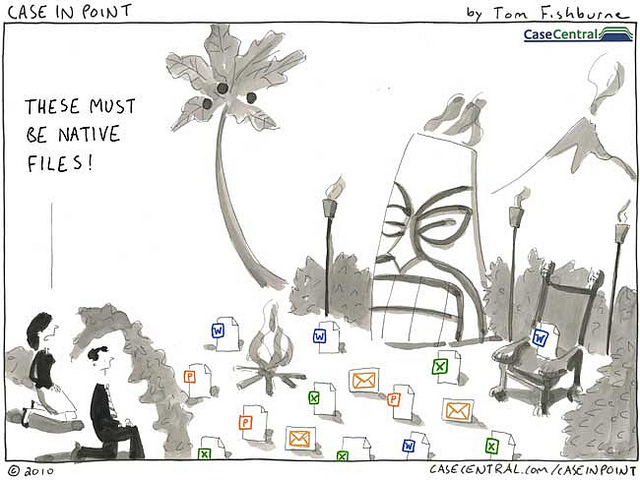
Production of documents in their “native file format” is gaining traction in litigation.  But, what exactly is a native file? And why should I care about it?

Native format is the file structure of an electronic document as defined by the application that created that electronic document.

So, for example, if a spreadsheet was created using Microsoft Excel, then that

Continue Reading What is a Native File and Why Does it Matter?

Recently, two separate New York courts (the First Department and the Southern District) issued decisions imposing sanctions upon litigants who failed to comply with preservation obligations.  While a summary of those decisions and hyperlinks to the full decisions follow, attorneys should take heed that it is critical to timely and properly issue litigation hold notices when litigation is reasonably anticipated.   

Continue Reading Sanctions in Two New York Courts for Party’s Failures to Preserve

We all know that it can be damaging to one’s case if a party to a litigation fails to preserve relevant information.  But when, exactly, does one’s duty to preserve (potentially relevant information) arise?  And what type of sanctions are federal courts imposing under the amended federal rules for preservation failures?

When Does One’s Duty to Preserve Arise?

Different jurisdictions

Continue Reading Failure to Preserve Emails Results in Sanctions

In the well-known saga commonly referred to as “deflategate,” (NFL Mgmt. Council v. NFL Players Ass’n., 2016 WL 1619883 [2d Cir. Apr. 25, 2016]) the Second Circuit upheld the arbitrator’s decision to suspend Patriots’ quarterback, Tom Brady.  Specifically, Brady, was suspended for four games after it surfaced that he participated in deflating the footballs used in Superbowl XLIX

Continue Reading Any Reasonable Litigant Should Understand Not to Destroy Evidence.

In Thurmond v. Bowman, 2016 WL 1295957 (W.D.N.Y. Mar. 31, 2016), a Fair Housing Act case, defendants moved for sanctions against the plaintiff alleging plaintiff deleted Facebook posts relevant to this lawsuit. The plaintiff argued that the posts were not deleted, but instead were “hidden” from public view.  Soon thereafter, plaintiff produced a printed set of most of the

Continue Reading Relevant Social Media Posts Cannot be Destroyed Nor Can They Be Hidden

In an insurance law class action suit pending in the Western District of Missouri (Labrier v. State Farm Fire & Cas. Co., 2016 U.S. Dist. LEXIS 61246 [W.D. Mo. May 9, 2016]), State Farm Fire & Casualty Company (“State Farm”) requested the district court vacate a Special Master’s discovery order. The plaintiff’s allegations were that State Farm

Continue Reading Difficulty in Assembling Responsive Electronic Data an Insufficient Reason to Deprive Litigant of the Critical Information

In a trademark infringement case pending in the Northern District of California (InternMatch v. Nxtbigthing, 2016 WL 491483 [N.D. Cal. Feb. 8, 2016]), plaintiff requested copies of any documents relating to the defendants’ defense that it had continually and pervasively used the trademark at issue.   The defendants were not able to produce many responsive documents and advised

Continue Reading Lightning Strikes and Power Surges Insufficient to Insulate Defendant from Discovery Sanctions

Chief Justice Roberts commented that the newly amended Federal Rule of Civil Procedure, Rule 26 “crystalizes the concept of reasonable limits in discovery through increased reliance on the common-sense concept of proportionality.”  This common sense approach was recently embraced by a Special Master, and then approved by the District Court Judge, in the products liability case In re Takata Airbag

Continue Reading Defendants’ Proposal to Redact Non-Relevant Information Recently Upheld under Newly Amended Rule 26